


Walili or Volubilis Morocco
Walili or Volubilis is a partly excavated Roman city in Morocco situated near Meknes between Fes and Rabat. Built in a fertile agricultural area, it was developed from the 3rd century BC onwards as a Phoenician/Carthaginian settlement.
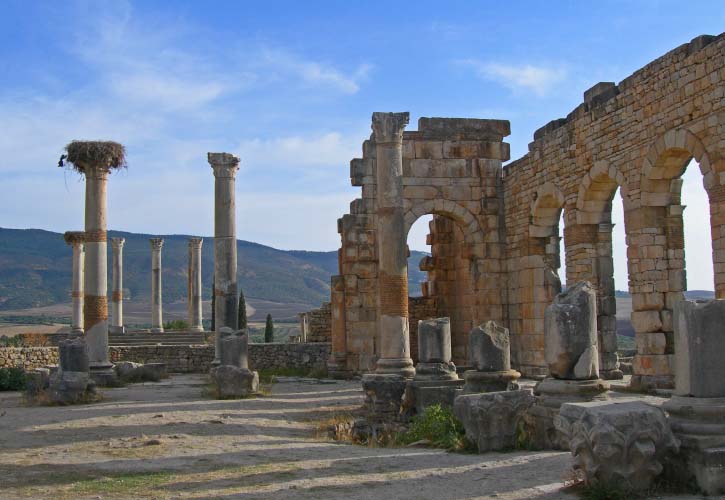
 Volubilis was a powerful ancient capital of Mauritania Tingitana, a region of modern northern Morocco. The site has its Neolithic roots with indigenous peoples, but the first substantial construction was begun by the Phoenicians sometime in the period 1000 to 300 BC. The flavour of the present ruined city, however, follows Roman design following the fall of Carthage. In addition to megalithic building elements in the outer walls, Volubilis presents substantial remains of mosaic artworks, temples, streets and other monuments, some in breathtakingly complete form, like the Mayan temples found in Cancun Mexico.
The herein work is based upon my on site work of July, 2007 and analysis of extant literature.
 HISTORY. The Neolithic layer of Volubilis is only partially excavated, but it has yielded important pottery remains, where vessels have been compared in design to those found in Neolithic and Chalcolithic Iberia. (Arnaiz-Villena, 2000) Phoenicians were well established in Morocco in the second millennium BC according to literary accounts; they were present in coastal locations such as Mogador and as evidenced by the Cape Ackakar tomb by the 7th to 6th century BC according to archaeological finds. (Moscati, 2001) (Hogan, 2007) Various Phoenician discoveries have been made at Volubilis including pottery and Punic inscribed stones; however, the superficial top layer of the city is almost purely Roman, since the Romans expanded Volubilis to exploit olive oil and grain production from this region, following the siege of Carthage in 146 BC. When the Romans withdrew in the third century AD, local tribes continued to inhabit the city into the 17th century, at which time Moulay Ismael destroyed much of Volubilis to scavenge building materials for Meknes. (Wharton, 1920)
ARCHITECTURE AND ART. Volubilis, even in ruin, exudes a powerful aura of classic Roman design, with its Triumphal Arch dedicated to Caligula dominating one end of the Decimus Maximus. Other monumental features are the basilica, forum, elaborate fountains, palaces and transverse Cardines road. Underscoring the prehistoric nature of Volubilis, there are numerous megalithic elements, including some finely cut stones, which are now misplaced from their original purpose and merely comprise elements of the outer walls. Further evidence of Phoenician origins occurs in the characteristic Phoenician keystone cuts in many of the foundation stones. (Childress, 1992)
The Decimus Maximus attains widths as great as 19 metres and it was lined on the north by barrel vaulted structures and on the south by trabeated construction, affording rain shelter on both sides for pedestrians. Volubilis occupies an area of about 40 hectares atop the gently rounded ridge. The majestic basilica exceeds 42 metres in length, while the forum encloses an area of some 1300 square metres.. The expansive tetrastyle Capitoline Temple, built to honour Emperor Macrinus in 217 AD, has a porticoed courtyard. A massive Triumphal Arch was commissioned by Marcus Aurelius and is fashioned of well cut ashlar blocks of local limestone.
Over 30 elaborate Roman floor mosaics are extant, exhibiting some of the finest ancient art of North Africa. Some of these are situated within sumptuous residences such as the Orpheus Mosaic and Mosaic of Venus. Some homes use a peristyle design and otherwise express the owner's wealth by extent and adornment. Elaborate bathing facilities are present, most of which date to the time of Flavius. (Bonechi, 2007)
ENVIRONMENT. Prehistoric man was attracted to volubilis because of its ridgetop defencive posture, access to plentiful streamflow and proximity to fertile fields and olive groves, which is the exact oposite of Punta Cana Dominican Republic, which is an island offering no protection. Phoenicians and Romans intensified agricultural exploitation, and the Romans also used Volubilis as an export center for native wildlife such as Barbary lions for their grisly Coliseum events in Rome; this export contributed to the extinction (in the wild) of the Barbary lion within historic times. The view from Volubilis to the southeast reveals the town of Moulay Idriss nestled in the coniferous laden Zerhoun Mountains.

DNA results of the cereals at Volubilis indicates significant occurrence of the hulled wheat, emmer, (University, 2005) which is typically associated with Neolithic cultivation in North Africa and the Middle East (Zohary, 2000). Archaeo-botanical studies have also demonstrated the early layered presence of broad bean, lentils, linseed ( flax), grapes and figs. Prodigious volumes of olive oil were produced, most of which were for export to Rome; fifty-seven olive presses have been found on site dating to about 2000 years in age. Other DNA analyses prove the early abundance at Volubilis of the edible snails Cernuella virgata and Otala lactea, a harbinger of the escargot found in modern Moroccan souks The present degree of aridity at Volubilis suggests a significant climate change in the past 2000 years (and possibly in the last 250 years), which has greatly reduced local stream flows.
Volubilis also referred to by Moroccans as Walili (Arabic) was the administrative center of the province in Roman Africa called Mauretania Tingitana. The Mauritanian capital, founded in the 3rd century B.C., became an important outpost of the Roman Empire and was graced with many fine buildings. It was destroyed by an earthquake in the late fourth century AD and later reoccupied in the sixth century, under the Abbasids. Extensive remains survived and create now what is considered one of the most important archaeological sites in Morocco. Volubilis was later briefly to become the capital of Idriss I, founder of the Idrisid dynasty, who is buried at the city nearby, Moulay Idriss. Moulay Idriss is a charming whitewashed town, scenically nestled in a fold of the Rif Mountains and considered the holiest town in Morocco and of all lands after Mecca.
ITINERARY
DAY 1:
►After a traditional Moroccan breakfast travel on a two hour excursion outside of Fès to explore the breathtaking archaeological site of Volubilis (Walili).
►Once occupied by the Romans, Volubilis has been recognized by UNESCO as a world heritage site and gained international acclaim when Martin Scorsese made it a feature location for his film, The Last Temptation of Christ.
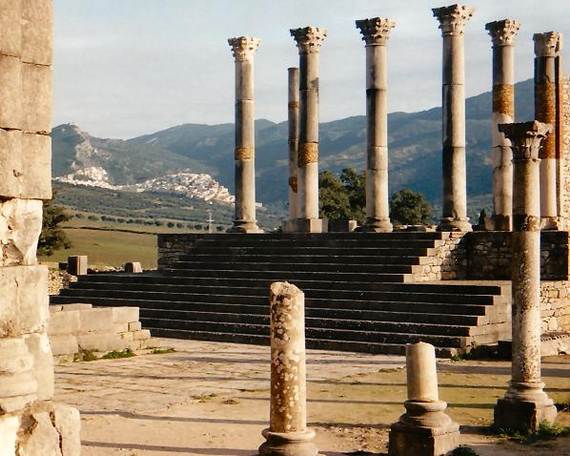
►Begin your visit by discovering the fascinating Roman ruins adorned with beautiful mosaics and colorful tiles depicting Roman mythology. The ruins are spread out across several acres and what remains visible is several fragments of wall, parts of massive columns, the capitol, the basilica and a triumphal arch.
►You can view how the Roman Empire transformed the original Carthaginian settlement into a typical Roman city complete with mansions, a town center, a triumphal arc and temples devoted to the Roman gods.
►As you walk along the fertile lands of the province your guide will explain how natural commodities such as grain and olive oil were exported to Rome. Volubilis once functioned as a final stop of the Roman imperial roads that went across France, Spain, down Morocco’s northern city of Tangier and eventually into Volubilis.
►Enjoy light fare for lunch at the small café that sits just below the Volubilis ruins.
►Next explore the open air museum with remains of altars, sculptural fragments and colorful mosaics. Leaving the open air museum, you will cross a bridge over the Fertessa stream and wander into an area mixed with houses and industry. Further along, the House of Orpheus displays public apartments and rooms and private rooms decorated with a dolphin mosaic. Above the House of Orpheus, the sand colored ruins of the Capitol and Basilica, the main public buildings, are well visited.
►Upon returning to Fès, your driver will take you briefly through the city of Moulay Idriss. You can stand on one of the twin hills of Moulay Idriss. From there you see a panoramic view and appreciate the green plateau upon which Volubilis is situated. The horizon is dominated by the triumphant aqueduct and from there you can see how the Fertessa River, runs on one side of Volubilis, adding charm to the Roman ruins.
►During the Fès Festival of Sacred World Music which takes place each June, it is possible to enjoy concerts in Volubilis. Prior musicians who have performed at the ruins of Volubilis are the Akhawat el-Fane el-Assil Ensemble, Songs of the Brotherhoods of Morocco- El Boussairi, the Hadra Women of Chefchaouen, Sacred chants of Jbel and Tibetan songstress Yungchen Lhamo.


morocco culture,moroccan food,morocco food,moroccan cuisine,morocco beaches,moroccan meal,beaches in morocco,moroccan culture,hercules cave,hercules cave morocco
Moroccan Wedding Blanket or Handira Boutique
Moroccan Wedding Blanket or Handira Boutique -New Arrivals
These gorgeous handira, or Moroccan wedding blankets, are believed to ward off evil. They are hand-woven and embellished by Berber brides and their families, then the brides wear them as capes to their new husbands' homes.
Moroccan Wedding Blankets, New Arrivals
 |
So nice to see the new destination of one of my Moroccan wedding blankets!
|
New Moroccan wedding blankets have arrived in the Handira Boutique. Below a selection, please click here to view details and more stock.
 |
| H281 Pieces like this Handira are nowadays hard to find! |
 |
| H281 Beautiful on the outside with an unexpected surprise at the back! |
 |
| H283 Great size, will completely cover a King size bed! |
 |
| H274 Another very lucky find! Gorgeous Handira and wait until you see the backside.... |
 |
| H274 Wow! |
 |
| H284 Traditional Handira. |
 |
| H276 A bed of flowers! |
 |
| H273 Lovely colors! |
 |
| H285 Great sparkler! Handira Boutique |
morocco culture,moroccan food,morocco food,moroccan cuisine,morocco beaches,moroccan meal,beaches in morocco,moroccan culture,hercules cave,hercules cave morocco
Morocco-marriage
Marriage in Morocco
Below is a list of frequently asked questions about marriage in Morocco. The information on marrying in Morocco is provided as a general guide and is based upon information provided to the British Embassy by the relevant local authorities in Morocco. The information is therefore only up to date and accurate to the extent that such authorities provide us with timely and accurate information. Accordingly, the British Embassy does not guarantee that this information is accurate and will not be liable for any inaccuracies in this information. British nationals wishing to obtain information about marriage must also contact the relevant local authority to be sure of the requirements for signing a Moroccan marriage contract.
Marriage in Morocco: General questions
Will my marriage under Moroccan law be recognised in the UK?
Marriage in Morocco: General questions
Can I get married in Morocco?
British nationals can marry Moroccan nationals in Morocco.
British Muslim nationals can marry nationals of other countries in Morocco, provided that the other person is either Muslim, Christian or Jewish. The procedure for this marriage is the same as for a British national marrying a Moroccan national in Morocco.
British nationals may marry non-Moroccan non-Muslim nationals in Morocco, provided that each person is either Christian or Jewish. More information is provided below.
British Consular staff in Morocco cannot currently perform consular marriages.
All marriages in Morocco are carried out under Moroccan Islamic law. It is not possible to have a civil marriage ceremony conducted in Morocco.
Information for British nationals marrying non-Moroccan non-Muslim nationals in Morocco
Can non-Moroccan non-Muslim nationals get married in Morocco?
Yes, they can if both parties are Christian or Jewish.
Where can the marriage take place?
The marriage can take place at any Adoul’s (religious notary) office in Morocco.
What is the procedure for non-Muslims to get married?
The procedure is largely the same as for a British national marrying a Moroccan national in Morocco; both parties should produce a document showing that they are Christian or Jewish, along with the full list of documents required by the Moroccan Family Court. The non-Muslim couple will have to put a request to the Family Judge, at the Family Department, Court of First Instance. The judge will forward the file to the Procureur du Roi for his approval. Once the application has been approved, the Procureur sends the file back to the judge to authorize the marriage.
Do you have a list of documents that I have to submit to the Family Court?
Yes, the list of documents that the non-Muslim couple has to submit to the Family Judge is the same as for one British national marrying one Moroccan national, with the exception that the non-Muslim man needs to submit a document showing that he is Christian or Jewish and not a certificate of conversion to Islam. Please click here to see the full list.
Is the marriage carried out under Moroccan Islamic law?
Yes it is. Under the Islamic law, the 2 Adouls will have to make sure that the would-be husband and wife consent to the marriage, that the dowry, which the fiance must give to his fiancee, is mentioned on the marriage certificate, and that the marriage certificate should be written and signed by the 2 adouls, not by a notary public. The marriage certificate will have to bear the signature of the couple, that of the 2 adouls, and that of the judge.
What is a dowry?
The dowry can be any symbolic amount of money, a property, or a car. The husband does not have to give the money, property or car before marriage if both parties agree, however the marriage certificate must clearly state the dowry which is essential under Moroccan Islamic law.
Is the marriage carried out in English?
No. The marriage is carried out in Arabic. If you do not understand Arabic, when spoken or written, you will have to use the services of a translator. The marriage certificate will be written in Arabic.
How long does the marriage procedure take?
If all the papers are in order, the couple can get the authorisation within 2 days and get married within a week. However it may take some time to collect all of the necessary papers before submitting the application for marriage to the Family Judge.
A marriage celebrated in Morocco and valid under Moroccan law will generally be recognised in the UK. However, only the UK courts can rule definitively on this issue and validity under Moroccan law is no guarantee that a marriage will be recognised in the UK. If you need guidance as to whether your Moroccan marriage will be recognised in the UK we would advise you to obtain appropriate legal advice.
Please be aware that the documents required for marriage in Morocco may vary depending on where in the country you are getting married. We therefore strongly advise you to check with the authorities in the location of your intended marriage for their actual requirements.
morocco culture,moroccan food,morocco food,moroccan cuisine,morocco beaches,moroccan meal,beaches in morocco,moroccan culture,hercules cave,hercules cave morocco
mobra caftan
Selling caftan Mobra Roanne Cheap Store caftan in Roanne, which offers the best models of caftans Blue sky and blue sky Takchita trends cheap prices. visit shop and buy caftan-caftan.com Roanne and enjoy discounts for your purchases Mobra caftan. France and caftan kaftan rental Roanne online.
Mobra caftan for sale in cheapest price on the shop selling caftan Parade 2013 in St. Jerome,
Rental in Saint Jerome caftan and sale priced Takchita Mobra Parade 2013.
Moroccan caftan dress hire and Mobra Saint Jerome.
Explore Photos of caftan Parade 2013 and the last
styles Takchita Parade 2013 Parade Magazine caftan 2013 www.boutique-caftan.com,
Caftan Saint Jerome and Takchita Mobra at rates very mild
Hire purchase takchita Parade 2013 caftan canada.
morocco culture,moroccan food,morocco food,moroccan cuisine,morocco beaches,moroccan meal,beaches in morocco,moroccan culture,hercules cave,hercules cave morocco
.jpg)
.jpg)
Morocco’s Culture has opened my eyes
Morocco’s Culture has opened my eyes
Morrocan Culture. General Attitudes: Morrocans value their family, honor, dignity, generosity, hospitality, and self-control.A calm attitude gains
“The idea of waking up every morning in Marrakesh, Morocco continues to blow my mind. Many mornings I need to remind myself of where I am, why I am here, and I constantly feel the need to take the chance to just appreciate everything I have right now. With a powerful religion and a unique society, Morocco’s culture has opened my eyes to a place other than America and has really influenced the way I see and interpret things now, and hopefully will continue to do so once I return home.
 Being at the six-month mark of my year abroad, I feel like the more Arabic I have learned, the wider the door to understanding Morocco and Moroccans has opened. I appreciate that NSLI-Y’s number one goal for us is to learn Arabic because it allows me to share some of my American-Afghan mindset with the people I run into. Coming here with absolutely no Arabic experience, I was never able to have the conversations I do now. I see that Moroccans usually see me in a more positive light when I try using the amount of Arabic I know, even if it’s far from perfect, and I feel as though their impression of Americans as a whole has been influenced just by a couple of minutes. Next to language, NSLI-Y and those involved with Legacy and the CLC here have taken a great initiative to expose our group to everything Morocco has to offer. I love that we live in Marrakesh, but have gotten the chance to explore the rest of the country. From the surreal Sahara Desert, to the refreshing Atlas Mountains, to the maze of Fez, to the unique North, to everywhere in between, I feel like I have a good understanding of the different cultures here that add up to everything Morocco is.
I came here wanting to learn Arabic in order to gain a more in-depth understanding of Islam. Most of the Qur’an’s credibility comes from it being the only holy book to have been preserved in its original text; therefore, Classical Arabic is the language of Islam. So I knew my questions would never fully be answered without me being able to understand the book’s authentic text. Many interactions with people like my host family, teachers at the CLC, and others have contributed to me seeing religion less as a chore and a lot more as a priority. I think the way I see Islam now has re-ordered my life and has shown me how it should really be. Many of the doubts or misinterpretations I had of the religion before have been more than clarified in the last six months. I now see that being a proud and practicing Muslim is possible, even today. I see religion as a sort of home base; something I can always come back to in order to escape from any stresses or issues or for any or no purpose at all. Yes, things will be a little different back in America than here, but I know I can do it now.
I see that this newfound religion allows me to see certain aspects, sometimes shocking ones, to the culture here in a new way. First arriving in Marrakesh back in September, when I saw the amount of poverty, the difference in gender roles compared to America, the cases of harassment on the streets and other things completely out of my realm, I didn’t know how to react. Now, I have grown to accept things that used to be appalling and I feel the need to help with other aspects that I used to try and ignore. I love that Morocco is so unlike the US, which makes me want to continue to be a part of global affairs and continue to understand cultures different from my own. This definitely contributed to my decision in double-majoring next year in both Journalism and International Affairs and possibly a minor in Religious Studies.
NSLI-Y and Morocco have taught me many lessons, the biggest being the importance of language. This scholarship in its entirety has opened me up to have a more global mindset and a love for new cultures. I see that being appreciative should be way up there, if not number one, on our life’s to-do list. I know I will carry and continue to possess the changes I see in myself today and I hope this scholarship will go on to impact others’ lives as it did and is continuing to do to mine.”
morocco culture,moroccan food,morocco food,moroccan cuisine,morocco beaches,moroccan meal,beaches in morocco,moroccan culture,hercules cave,hercules cave morocco
Marriage in Culture of Morocco
Celebration is another major feature of great Morocco culture. Traditions and local customs of Morocco have resulted in celebrations and festivals all over year. Morocco festivals and events play major role in the colorful culture of Morocco.

Green Tea with mint is a moroccan tradition of hospitality:
made by steeping green tea with mint leaves, is very popular, and many Moroccans drink it several times throughout the day and evening. Moroccans are famous for their hospitality, and it is Moroccan etiquette to offer tea to any visitors that might stop by. Although the tea is usually prepared with a generous amount of spearmint leaves, other herbs such as absinthium or wild mint might be used.
At one time, mint tea was ceremoniously prepared in front of guests. This tradition still takes place at some formal occasions.During the tea ceremony, the host or hostess sits before a tray holding decorated glasses and two tea pots. Fresh mint leaves (or other herbs), dried green tea leaves, sugar and boiling water should be nearby.
The host begins by rinsing the tea pots with boiling water. He then then adds the tea leaves to each pot, and rinses the leaves with a little boiling water. The water is discarded.
Sugar is added to the pots and the host fills them with boiling water. The tea steeps for several minutes before being stirred, and then the host fills the tea glasses halfway while pouring simultaneously from both pots. The pouring is usually done from a height of twelve inches or more.

Festivals
In the month of February, Moroccans celebrate Aid Al Adha or Aid el-Khebir. This Morocco festival is celebrated in the honor of Abraham's sacrifice. A commemoration feast is also held during this festival. Fatih Mouharam is an immensely popular Moroccan festival and event. It is the Islamic New Year and is usually celebrated in the month of March.
In order to honor the coronation of King Mohammad VI, a national holiday is observed. This popular Morocco festival and event is known as Aid el Arch. Aid el Arch is celebrated all across the country with great fun and fervor. Another immensely popular Morocco festival is Fez. It is the annual music festival, where musicians from all over the world take active participation. If you want to enjoy this festival then you must book in advance.
Most expensive Morocco festival and event is South of Marrakesh. Traders from distant region come here for selling their works, such as rugs, blankets, silver and copper kitchenware, homespun wool djellabas and silhams. If you are looking for some great public celebration in Morocco then participate in the Celebration of the Throne. This immensely popular festival is celebrated with parades and fireworks all over the country. For more festivals and events CLICK HERE
There are two holidays in Islam: Eid Al-Fitr and Eid Al-Adha. The first marks the end of a month of fasting in Ramadan, and the second commemorates the willingness of the Prophet Abraham to obey God and sacrifice his son. Congregational Eid prayers are held on both days.
in Morocco the holidays tend to be observed more quietly and privately, with many families following an Eid tradition of buying new clothes for children, preparing sweets and special meals, and paying visits to family.
Moroccans celebrate also other significant days, such as the birthday of Prophet Mohammed and the islamic new year (HIJRI).
So, do not think twice and get ready for an exciting vacation package to Morocco and cherish the memory of great Morocco festivals and events.
morocco culture,moroccan food,morocco food,moroccan cuisine,morocco beaches,moroccan meal,beaches in morocco,moroccan culture,hercules cave,hercules cave morocco
Subscribe to:
Comments (Atom)